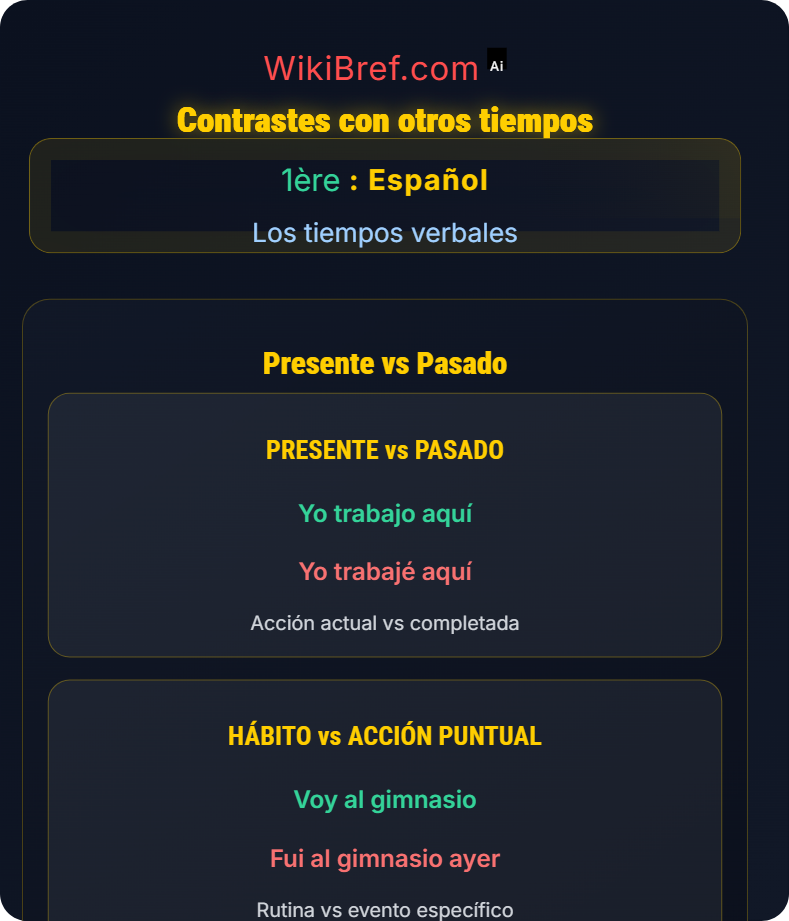
Présent vs Autres temps
PRESENTE ≠ OTROS TIEMPOS
Différences d'usage et de sens
| Temps | Usage | Exemple |
|---|---|---|
| Presente | Action actuelle/habituelle | Yo trabajo aquí |
| Pretérito indefinido | Action terminée dans le passé | Yo trabajé aquí |
| Imperfecto | Action continue dans le passé | Yo trabajaba aquí |
| Futuro simple | Action future | Yo trabajaré aquí |
Caractéristiques
Présent = Actualité
Passé = Terminé
Futur = Projet
Imperfecto = Habituel
Présent vs Passé
Présent (habitude actuelle):
Yo estudio español → I study Spanish (maintenant)
Trabajo todos los días → I work every day (maintenant)
Vivo en Madrid → I live in Madrid (maintenant)
Trabajo todos los días → I work every day (maintenant)
Vivo en Madrid → I live in Madrid (maintenant)
Passé (action terminée):
Yo estudié español → I studied Spanish (dans le passé)
Trabajé aquí ayer → I worked here yesterday
Viví en París hace dos años → I lived in Paris two years ago
Trabajé aquí ayer → I worked here yesterday
Viví en París hace dos años → I lived in Paris two years ago
Présent vs Futur
Présent (réalité actuelle):
Es lunes hoy → It's Monday today
La tienda abre a las nueve → The store opens at nine
Soy estudiante → I am a student
La tienda abre a las nueve → The store opens at nine
Soy estudiante → I am a student
Futur (projet/plan):
Mañana estudiaré español → Tomorrow I will study Spanish
El próximo año viajaré → Next year I will travel
Probablemente trabajaré allí → I will probably work there
El próximo año viajaré → Next year I will travel
Probablemente trabajaré allí → I will probably work there
Présent vs Imparfait
Présent (habitude actuelle):
Yo juego fútbol cada fin de semana → I play football every weekend (maintenant)
Leo libros por placer → I read books for pleasure (maintenant)
Siempre desayuno temprano → I always have breakfast early (maintenant)
Leo libros por placer → I read books for pleasure (maintenant)
Siempre desayuno temprano → I always have breakfast early (maintenant)
Imparfait (habitude passée):
Yo jugaba fútbol cada fin de semana → I used to play football every weekend
Leía libros por placer → I used to read books for pleasure
Siempre desayunaba temprano → I always used to have breakfast early
Leía libros por placer → I used to read books for pleasure
Siempre desayunaba temprano → I always used to have breakfast early
Erreurs fréquentes
Erreur 1:
Utiliser le présent pour des actions terminées dans le passé
Erreur 2:
Confondre l'imparfait et le présent pour les habitudes
Erreur 3:
Ne pas distinguer actions ponctuelles et habituelles
Astuces & Méthodes
Présent = Réalité actuelle
Passé = Action terminée
Futur = Projet/plan
Imparfait = Habitude passée
Contexte détermine le temps